
What Are Zero-Fee International Transfers & Are They Really Free?
-
Author
Rishi Agarwal -
Date
April 2, 2026 -
Read Time
10 min
TABLE OF CONTENTS
Money-transfer apps often advertise “zero fees” on international transfers, which sounds great for NRIs in Europe sending cash home. In reality, “zero fee” usually means no upfront charge but the provider may still earn through the exchange rate or other costs. For example, some services waive transfer fees but add a hidden markup: they give you a slightly lower EUR→INR rate than the true mid-market, effectively charging for the service without saying so. In other cases, “free” may only apply to your first transfer or a limited amount.
Even without a visible fee, check the actual rupees per euro you’ll get. Some apps claim to match this “Google rate” or even beat it. For instance, an NRI-focused app guarantees “Google rates” on transfers, meaning the raw forex rate. Others advertise giving you extra rupees on top of the mid-market price. That small margin does boost what your family receives, but it’s also how the app sustains its business without charging a fee.
How “Zero-Fee” Providers Actually Work
In practice, there are two main models:
- True zero-fee, low-margin apps: A few fintech companies (like Afriex) really absorb costs without up-front charges. They keep exchange rates very close to mid-market and rely on volume, partnerships or premium features for revenue. Afriex states that it charges Zero to low transfer fees and aims to keep exchange rates close to the mid-market, without hidden deductions. If you send money often, eliminating per-transfer fees can save a lot (e.g. saving $200 a year if you avoid even a $10 fee each time for about 20 transactions).
- Fee-waiver promotions: Many established services waive fees as a one-time promotion or for limited transfers. For example, TransferGo offers the first two transfers for free. Remitly commonly advertises fee-free first transfers for new customers as part of promotional offers, though terms vary by corridor and time period. But after that, small fees or unfavourable rates apply. Always read the fine print: a “free” transfer with a worse rate can end up costing you just like a direct fee would.
Hidden Costs of “Zero Fee” Transfers
Even when no transaction fee is charged up front, watch for these pitfalls:
- Exchange-rate markups: The biggest cost is usually in the rate. If the interbank rate is, say, 1 EUR = ₹105.80, a service might offer ₹105.50 instead. That 30 paise/€ gap is a hidden fee. Even small exchange-rate markups can add up significantly on larger transfers, sometimes exceeding the cost of visible transfer fees. In the present example, 30 paise on €1000 is ₹300 (~€2), similar to or more than many advertised “zero fees”.
- Receiving-bank fees or wallet charges: Some apps guarantee no fees on the sender’s side but your family’s bank or mobile wallet might deduct a charge. Always confirm that your recipient’s bank won’t take a cut. True zero-fee models promise “no hidden deductions… the amount you send is the amount your family receives”.
- Limits and conditions: Check transfer limits, required promo codes, or if zero fees are “only for first transfer.” If you send money regularly, having only the first transfer free is far less useful than no fees on every transfer.
Europe-to-India Transfers: What to Compare
For NRIs in Germany, France, Netherlands or elsewhere in Europe, popular remittance apps and banks compete fiercely. Key factors include rate vs. fee, transfer speed, and reliability. Here are some points to consider:
- Exchange rate vs. mid-market: Always compare the offered EUR→INR rate to the live market rate (also called the “Google” rate). Some apps proudly use actual mid-market rates; others add a small margin above the mid market rate (e.g. ScopeX’s +25 paise/€). Even 0.25 rupees per euro on a €500 transfer is ₹125 extra – modest savings.
- Fees: If a service truly has zero fees, that’s a big advantage. For example, ScopeX advertises “Zero fees” on every transfer. TransferGo waives fees for the first two transfers and then charges low fees per transfer. Wise (TransferWise) is known for tiny transparent fees (around 0.1% – 0.5%). Traditional banks, by contrast, often charge a fixed fee (~€10 or more) plus a markup on the rate. Global studies have historically estimated average remittance costs was 6.49% in March 2025, though actual fees vary widely by provider (bank), corridor, and payment method, so any zero-fee deal can really add up to savings over time.
- Speed and convenience: Many modern apps (including ScopeX) boast fast delivery. ScopeX claims 85% of transfers arrive in 30 minutes or less. TransferGo advertises instant transfers via bank account or card (with “zero fees” if you link a local account). Pay attention to cut-off times and delivery methods (bank deposit vs. cash pickup vs. wallet).
- Supported banks and countries: ScopeX offers broad bank coverage across Europe and India, encompassing many major banks; however, availability varies depending on the specific institutions of the sender and recipient. Other services also cover major banks, but always check if your specific bank (for example, BNP Paribas in France or ING in the Netherlands) works. NRIs in Spain or Italy who regularly compare providers before each transfer often find that using a corridor-specific service to send money from Spain to India or send money from Italy to India gives them a clearer picture of the actual zero-fee benefit specific to their corridor.
- Security and reputation: Use regulated, well-reviewed services. ScopeX is a “trusted & encrypted” platform with 20k+ happy users with many positive reviews. Users praise the ScopeX favourable rates compared to commonly referenced market rates. TransferGo is licensed in the UK/EU and has 7 million customers.
Comparing Transfer Options
Below is a quick comparison to illustrate how costs can vary on a €500 transfer to India:
- Local bank transfer: Might charge ~€10 fee (varies with individual bank) + ~2% hidden in a poorer rate. That could cost you ~€20 total (€10 fee + ~€10 lost to rate). You’d pay roughly €20 for the transfer.
- ScopeX (zero-fee app): No fee, rate = mid-market + 0.25 INR/€. At mid-market ~₹106, you’d get ~₹106.25/€. On €500, that’s ₹53,125 vs. ₹53,000 at mid-market – ₹125 extra. You save ~€20 since there are no fees. Net you gain ~€18 worth of rupees compared to the bank example (after accounting for the 0.25 markup).
- TransferGo (app): First two transfers free. After that, low fixed fees. If you do a free transfer via a bank account, you’d pay nothing in fee. Many users report that TransferGo’s rates are good for Euro corridors.
- Remitly (app): Often zero fee first transfer. Thereafter, small fees or slightly lower rates. Easy to use but not always the very best rate on large amounts.
- Wise (mid-market leader): If sending USD or GBP from Europe, Wise gives a true mid-market rate with about 0.2 – 0.5% fee. Wise is usually known for its transparency.
- Western Union / Xoom: Traditional money-transfer companies. They often charge sizable fees unless you find a special deal. Speed can be instant (cash pickup) but at a cost. For bank-to-bank, WU fees are usually €0–€5 plus a bigger rate margin.
Tips for Senders (Germany, France, Netherlands, etc.)
- Compare final received amount: Before sending, use a rate calculator or quotes. See how many rupees per euro you and your recipient actually get. Some providers show “You send EUR, recipient gets INR” estimates upfront.
- Test with a small transfer: The first time you try a new service, send a modest sum. Check how long it takes and how much it lands in INR. Real-world experience will tell you if “zero fee” holds up.
- Watch for hidden fees: Read FAQs and fine print. If a service is truly zero-fee, they will stress it. But if it’s a promo, it will mention “first transfer” or have a cap.
- Leverage fast speeds: If speed matters (for example, emergencies, bill payments), note transfer times. Many euro-to-INR apps boast same-day or even minute transfers in Europe-India corridors. NRIs in Ireland or the Netherlands who need to act quickly can send money from Ireland to India or send money from Netherlands to India through platforms that combine zero-fee transfers with near-instant delivery.
- Security first: Pick apps that are regulated by European authorities (FCA, EU) and work with established banking partners. Avoid anything that feels sketchy or isn’t transparent about licensing.
- Use local payment methods: Often bank transfers to the app are cheapest (though slower), while card payments might be faster but incur a fee. When an app says “free via bank account”, it means no app fee, but your own bank might charge EUR 0.
So, Are They Really Free?
In summary: Zero-fee promises can be genuine or marketing. Many apps don’t charge a separate fee, but they may rely on a small exchange-rate margin or other revenue streams (referral programs, volume deals, etc.). Others waive fees only as a promotion or for certain payment methods.
The key is to look at the overall cost: fee plus rate plus speed. For Europeans sending to India from Germany, France, Netherlands, and beyond, a deal that skips a €10 fee with very low margins (for example only ₹0.25 per euro) is often still better than paying that fee. Over time and multiple transfers, true zero-fee models can save hundreds of euros. But always confirm with a live rate check or small transfer. NRIs sending from France or Austria can also benefit from exploring dedicated options to send money from France to India or send money from Austria to India, where corridor-specific platforms often make the zero-fee promise more consistent and transparent than general international services.
Takeaway
- Zero up-front fees are attractive, but always check the exchange rate. If you compare the final INR you and your family get, you’ll know the real cost.
- Speed, support, and coverage also matter. Students in Berlin report ScopeX transfers are smooth and quick (most landing in 30 min) and trust it since it was created by Indians for Indians.
Ultimately, compare the all-in cost: for example, on sending €500, is it cheaper to pay a bank’s €10 fee and get the bank’s rate, or to pay €0 and accept a slightly adjusted rate? Often the zero-fee apps come out ahead. Just be smart: verify that “no fee” really means no extra deductions anywhere.
By doing a bit of homework on rates and fees for Germany, France, or Netherlands banks, you can be confident you’re using the best NRI money transfer app. Whether it’s a traditional service or a new app, what matters is getting the most rupees delivered safely and quickly.
Sources & Disclaimer:
The information in this article is based on publicly available provider disclosures, marketing materials, industry reports, and general remittance market practices at the time of writing. Exchange rates, fees, transfer speeds, and availability may vary by country, payment method, bank, and time period.
Company names mentioned are included for illustrative and comparative purposes only. Any performance metrics, pricing examples, or user experiences referenced reflect advertised claims or individual reports and should not be treated as guarantees. Readers are encouraged to verify live rates, fees, and terms directly with the service provider before initiating a transfer.
This content is intended for informational purposes only and does not constitute financial advice, investment advice, or a recommendation of any specific service.

Rishi is a Chartered Accountant (ICAI) and CFA (USA) currently heading Finance at ScopeX Fintech. With experience spanning fintech operations and strategic financial leadership, he writes sharp, practical insights on fundraising, financial modeling, risk, and more, bridging the gap between theory and the real fintech world.
RELATED ARTICLES
-
Wire Transfer vs Money Transfer App: Sending USD to India Compared
Quick Summary If you are choosing between a bank wire and an app for a US-to-India transfer, here is the short version. A wire transfer pushes dollars through the SWIFT and correspondent banking network. A money transfer app collects dollars in the US and pays out rupees through an Indian partner bank on domestic rails. […]
-
Cheapest Way to Send Money from Europe to India (2026 Guide)
Quick Summary The cheapest way to send money from Europe to India is the app that delivers the most rupees after both the transfer fee and the exchange rate margin, not the one with the biggest “zero fee” label. Every transfer has two costs: the upfront fee and the hidden exchange rate margin. Judge apps […]
-
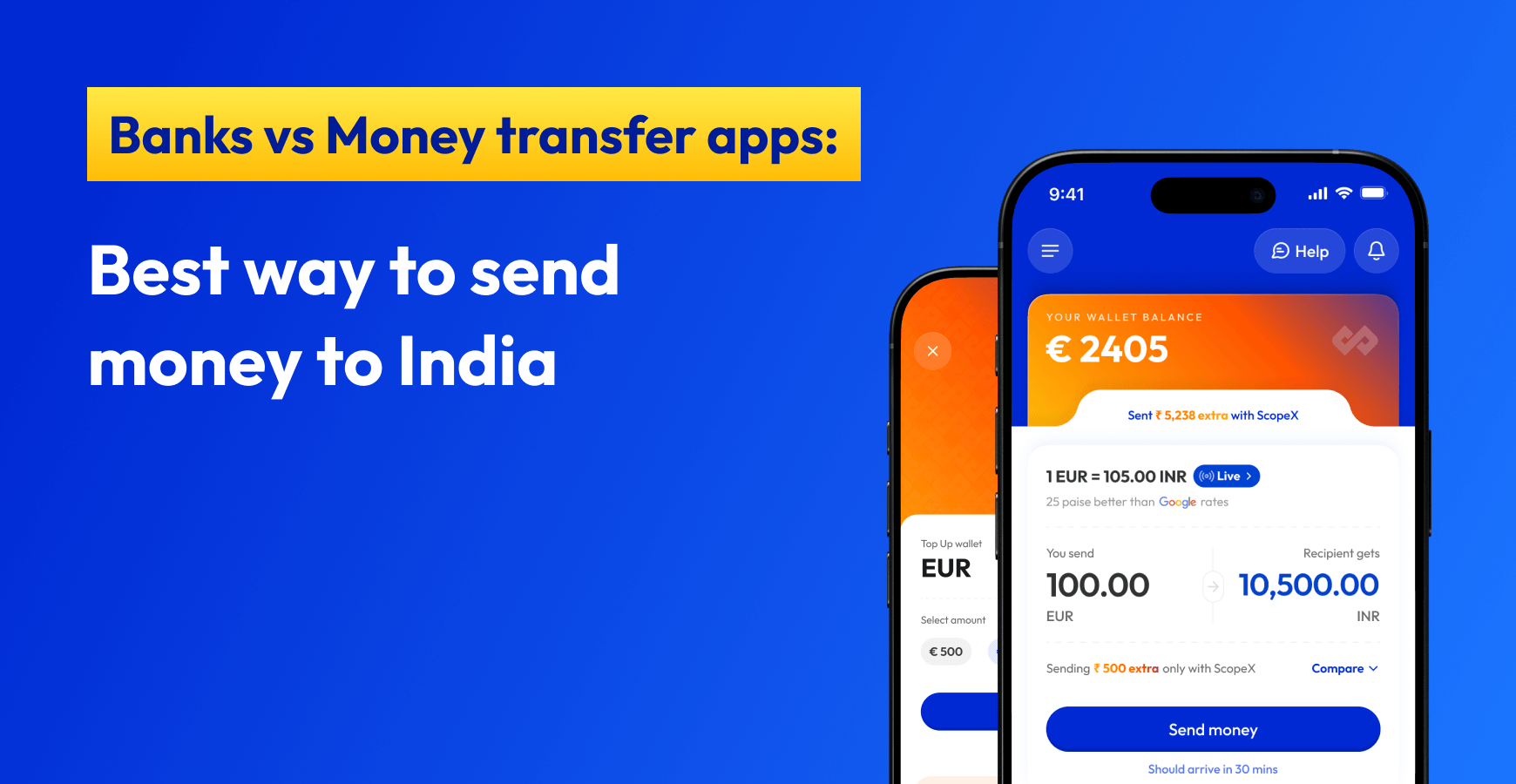
Banks vs Money Transfer Apps: Best Way to Send Money to India
Banks vs Money Transfer Apps: Best Way to Send Money to India Sending money from Europe to India can cost more than you expect. Traditional banks are reliable, but they charge high fees and take days to process an international transfer. In contrast, modern money transfer apps promise fast, low-cost transfers with transparent rates. This […]