Is It Safe to Send Money to India Online? Security Explained
Sending money from Europe to India is common for families and workers. In fact, India received a record $135.46 billion in remittances in FY 2025 by Indians working abroad. With so much at stake, safety is key. The good news is that online transfers are very safe, when you use the right platforms. Major remittance services use strong encryption (often 256-bit SSL) and strict fraud monitoring to protect your data and funds. Always pick a licensed and regulated provider. For example, ScopeX is a blockchain-based money transfer service covering Europe and India, promising fast, transparent, and secure transfers. These providers display live rates and give status updates so you know exactly when your funds reach the recipient.
What are the Security tips we should consider?
- Use regulated providers: Choose companies licensed by financial authorities in your country. Regulated platforms follow strict rules for anti-fraud and customer protection.
- Check for HTTPS/SSL: Always confirm the website or app uses a secure connection (look for “https://” and a lock icon). This encrypts your login and banking details.
- Verify recipient details: Before sending, double-check your recipient’s name, bank account number, and IFSC code. A small typo can send money to the wrong account.
- Watch out for scams: Legitimate services will never pressure you or ask for secret codes. Never send money for unexpected lottery wins or online purchases from unknown sellers.
- Use strong authentication: Enable two-factor authentication on your account if offered. This adds a second layer (like a code sent to your phone) whenever you log in.
- Keep devices safe: Use updated antivirus software and avoid public Wi-Fi when initiating transfers. Fraudsters often target unsecured networks.
If you follow these steps, sending money internationally is very safe. But, scammers keep inventing tricks, but a cautious approach; verify everything twice, is your best defense.
Who is more secure; Money Transfer Apps vs Banks?
When sending remittances to India, you have two main paths; banks or online remittance apps. Both are secure, but they differ in cost and speed.
- Banks (wire transfers): These use networks like SWIFT. Banks are heavily regulated and have a long track record, so many people trust them. They offer strong security and compliance. However, banks charge slightly higher fees and transfers can take several days. For very large amounts (such as property purchases or business contracts), a bank transfer’s extra security may be worth the wait and cost.
- Online Money Transfer Apps/Services: These platforms (ScopeX, Wise, Remitly, InstaReM, Aspora, etc.) specialize in remittances. They typically cost less per unit transfer. Online services use digital technology to cut costs. This means lower fees, sometimes even zero upfront fees, and closer to the mid-market rate. They are also much faster; some apps complete transfers within minutes or hours.
Deciding which to use depends on your needs:
- For large businesses, occasional transfers, a bank or wire via your bank might give extra peace of mind.
- For frequent or smaller transfers, a remittance app usually wins in price and speed. Many people who regularly send money say that fees quickly add up, so saving on each transfer is important.
EUR–INR Real-Time Rates and Best Rates
Exchange rates move constantly. As of late 2025, one euro buys roughly ₹104 - 105 (for example, 1 EUR = 105.0848 INR on Dec 22, 2025). Rates have even touched ₹106.86 in 2025. A few paise can matter a lot: on €10,000, a 0.25 rupee gain per euro equals ₹2,500 extra. Hence, always check the mid-market (interbank) rate before making a transaction.
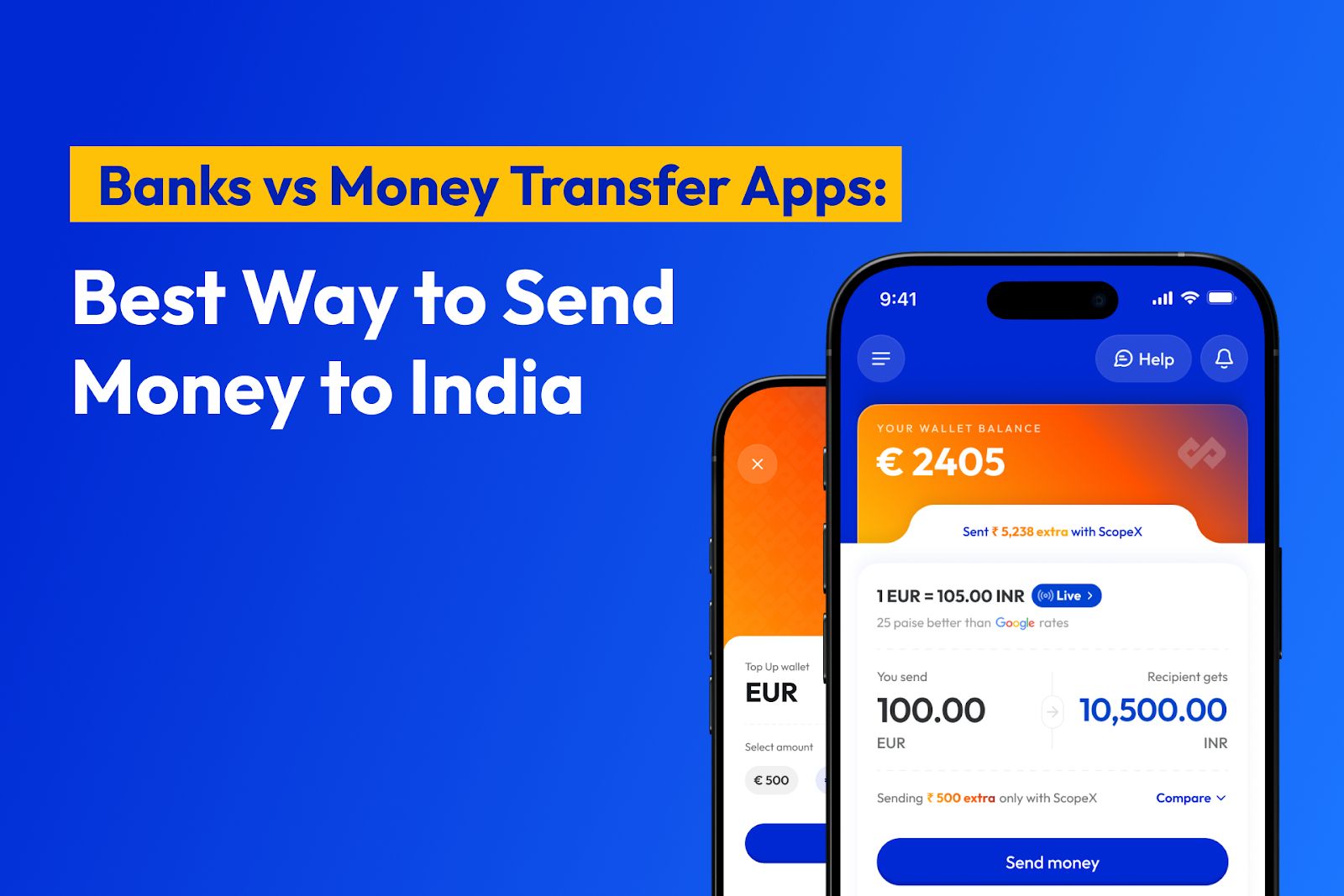
Most apps show you their live rate. For instance, ScopeX’s app screen (above) displays a live EUR→INR rate alongside how many rupees your recipient will get.
Tips for locking at best rates:
- Watch the rate: Use a converter or the app’s update feature. Rates fluctuate with global markets. If the rupee weakens, you get more INR per euro, so timing can help. No need to chase peaks, but awareness can save a few extra bucks.
- Compare mid-market vs offered: The mid-market rate (like 1 EUR = ₹105.08) is what Google shows. Providers may offer slightly different rates. Check providers’ “best rates” before making a transaction.
- Use alerts or locks: Some services let you lock in today’s rate for a short time for a small fee or free. This prevents rate changes between your initiation and completion.
- Avoid weekends: FX markets are closed Saturday - Sunday, so transfers done Friday evening may use Thursday’s rate until Monday. If possible, transfer on a weekday.
By staying informed, you maximize your amount. Remember: “Exchange rates determine how much money actually reaches your recipient”, even a small change in rate can add up. Always aim for a provider that is transparent about exchange margins.
Zero-Fee International Transfers
Today many apps offer zero-fee transfers as a headline. This usually means they charge no flat fee. For example, ScopeX advertises “Zero fees. More rupees”, other services might waive fees above certain amounts or have promotions like free first transfers. However, “zero fee” doesn’t always mean truly free; always confirm the total cost by checking the transfer summary. Some providers with no visible fee make a small cut on the exchange rate instead.
The advantage of the Zero Fee app is clear; more of your money goes to your family. For example, getting an extra ₹0.25 on each euro you transfer using ScopeX, means an extra ₹250 on a €1,000 send. Over time that adds up. Hence, it is suggested to always compare total INR received after all fees and rate margins.
Conclusion
Using a regulated, secure service protects your funds and personal data. Always verify who you’re sending to, and double-check all details. When it comes to costs, compare fees and exchange rates, a low or zero fee is great, but the exchange rate often has hidden costs.
There are more good options today than ever. For instance, ScopeX leverages blockchain to make euro–rupee transfers fast and transparent. Because they charge no transfer fee and give extra paise per euro (around 25 paise more than the Google mid-market rate). Ultimately, pick a service that fits your requirement; whether a known bank or a transfer app. With the right precautions, sending money from Europe to India online is not only safe, but also smarter and cheaper than it used to be.
Sources & Disclaimer
The information in this article is based on publicly available provider disclosures, marketing materials, industry reports, and general remittance market practices at the time of writing. Exchange rates, fees, transfer speeds, and availability may vary by country, payment method, bank, and time period.
Company names mentioned are included for illustrative and comparative purposes only. Any performance metrics, pricing examples, or user experiences referenced reflect advertised claims or individual reports and should not be treated as guarantees. Readers are encouraged to verify live rates, fees, and terms directly with the service provider before initiating a transfer.
This content is intended for informational purposes only and does not constitute financial advice, investment advice, or a recommendation of any specific service.