Why the NRI Quota Matters for Overseas Indians
For many Indian families living abroad, education in India remains an important consideration—whether for cultural continuity, affordability, or access to specific institutions. The NRI quota is often discussed in this context, but it is also widely misunderstood. Parents and students frequently assume it guarantees admission or applies uniformly across institutions, neither of which is true.
The NRI quota is a structured admission pathway governed by institutional rules, regulatory bodies, and eligibility criteria. Understanding how it works helps families plan realistically, avoid misinformation, and prepare the right documentation well in advance.
What Is the NRI Quota?
The NRI quota is a category under which certain Indian educational institutions reserve a limited number of seats for Non-Resident Indians and their dependents. These seats are typically available in private or deemed universities and are more common in professional courses such as engineering, medicine, dentistry, and management.
Unlike general merit seats, NRI quota seats may have:
- Different fee structures
- Separate eligibility criteria
- Institution-specific admission processes
There is no single national NRI quota policy; rules vary by institution and course.
Who Is Eligible Under the NRI Quota?
Eligibility under the NRI quota generally includes:
- NRIs holding an Indian passport
- Children or wards of NRIs
- In some cases, Overseas Citizens of India (OCI), depending on institutional rules
Eligibility is not automatic. Institutions often require proof of NRI status and relationship with the sponsoring NRI.
Typical documents include:
- Valid passport of the NRI sponsor
- Visa or residence permit
- Proof of relationship (birth certificate or affidavit)
Which Courses Commonly Offer NRI Quota Seats?
NRI Quota Seats are most commonly found in:
- Engineering and technology programs
- Medical and dental courses (where permitted by regulators)
- MBA and management programs
- Certain undergraduate professional courses
Availability depends on approvals from regulatory bodies such as AICTE, NMC, or UGC, and may change from year to year.
Fee Structure Under the NRI Quota
One of the defining aspects of the NRI quota is the fee structure, which is typically higher than that of general category seats.
Key points to understand:
- Fees are often denominated in foreign currency or INR equivalent
- Payment schedules may differ from regular seats
- Refund policies can be stricter
Institutions justify higher fees on the basis of infrastructure, international exposure, and cross-subsidisation.
Admission Process: How It Typically Works
The admission process under the NRI quota is usually institution driven.
While procedures vary, most institutions follow these steps:
- Separate application under the NRI category
- Verification of eligibility and documents
- Merit assessment based on qualifying exams
- Offer of admission subject to fee payment
Some institutions still require minimum entrance exam scores, even under the NRI quota.
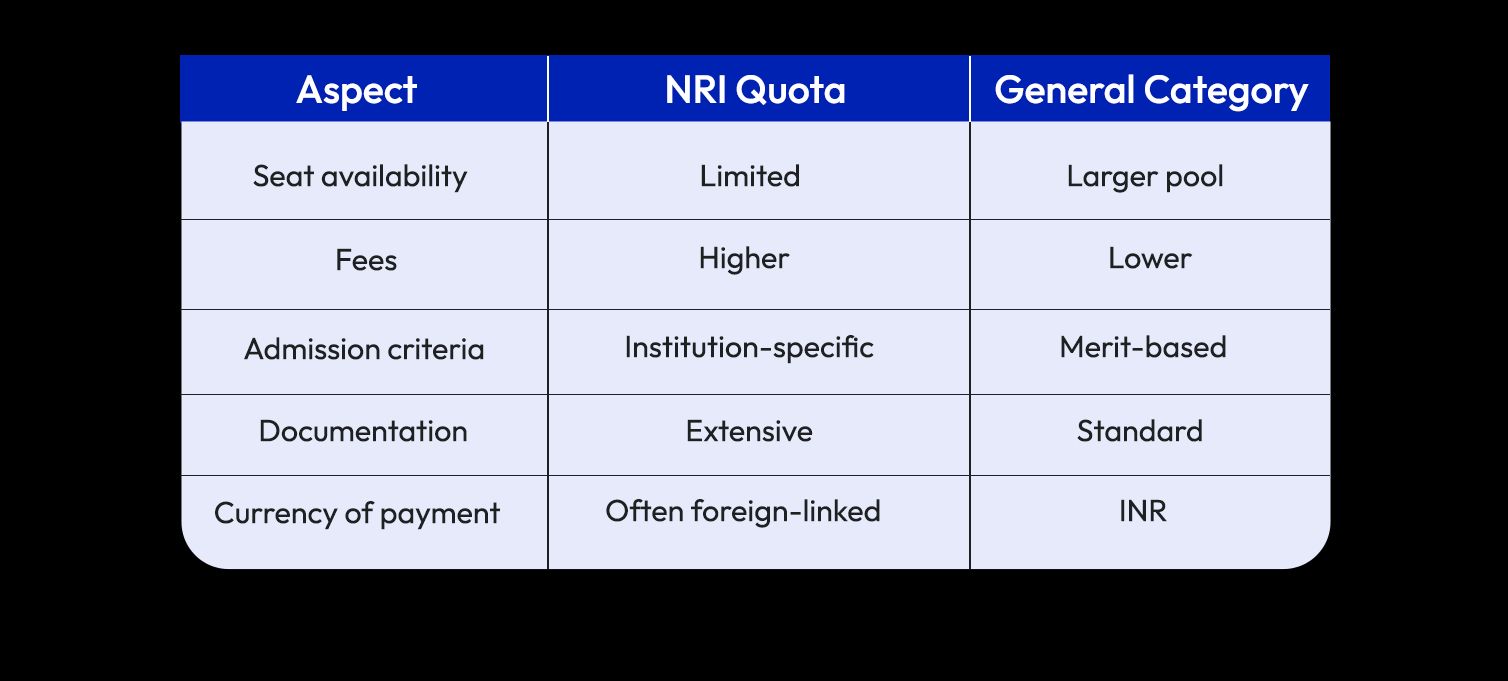
This comparison highlights why expectations must be aligned with institutional policies.
Common Misconceptions About the NRI Quota
Many families assume the NRI quota guarantees admission or bypasses academic requirements. In reality:
- Minimum eligibility criteria still apply
- Seats are limited and competitive
- Documentation scrutiny is strict
Late applications or incomplete paperwork are common reasons for rejection.
Regulatory Oversight and Compliance
While institutions have flexibility, they must operate within frameworks set by Indian regulators. Changes in policy—especially for professional courses—can impact availability, fee caps, and eligibility rules.
Families should always refer to:
- Official institution notifications
- Regulatory body updates
- Admission brochures for the current academic year
FAQs: NRI Quota in India
Does the NRI quota guarantee admission?
No. Admission depends on eligibility, merit, and seat availability.
Are OCI cardholders eligible under the NRI quota?
Some institutions allow OCI candidates, but policies vary.
Is the NRI quota available in all colleges?
No. It is mainly offered by private and deemed universities.
Are entrance exams required under the NRI quota?
Often yes. Many institutions still require qualifying scores.
Can fees be paid from India?
Payment rules vary, but institutions often require proof of NRI sponsorship.
Final Thoughts
The NRI quota offers an additional admission pathway for overseas Indians, but it is not a shortcut or guarantee. Its structure, fees, and eligibility criteria differ widely across institutions, making early research essential.
For families considering education in India under the NRI quota, realistic planning, timely applications, and thorough documentation are the keys to navigating the process smoothly and avoiding last-minute surprises.
Sources & Disclaimer
The information in this article is based on publicly available provider disclosures, marketing materials, industry reports, and general remittance market practices at the time of writing. Exchange rates, fees, transfer speeds, and availability may vary by country, payment method, bank, and time period.
Company names mentioned are included for illustrative and comparative purposes only. Any performance metrics, pricing examples, or user experiences referenced reflect advertised claims or individual reports and should not be treated as guarantees. Readers are encouraged to verify live rates, fees, and terms directly with the service provider before initiating a transfer.
This content is intended for informational purposes only and does not constitute financial advice, investment advice, or a recommendation of any specific service.