
EUR to INR Rate: 7 Powerful Tips to Get the Best Transfer Value in 2026
-
Author
Rishi Agarwal -
Date
May 29, 2026 -
Read Time
8 min
TABLE OF CONTENTS
The EUR to INR rate is the single biggest factor that decides how many rupees your family in India actually receives when you send money from Europe. It moves every second of every weekday, and even a half-rupee shift on a €2,000 transfer can mean a thousand rupees more or less in the recipient’s account.
As of May 2026, the EUR to INR rate is trading around ₹111, having reached a recent high of ₹112.36 earlier this month. It has swung between roughly ₹108 and ₹112 over the past 90 days. This guide breaks down why that matters, what drives the EUR to INR rate, and how to time and structure your transfers to get the best value.
Why the EUR to INR Rate Matters for Your Transfer
Every euro you send is converted to rupees at the prevailing EUR to INR rate. That rate moves up or down based on global markets, and a 1–2% change can add or subtract thousands of rupees on larger transfers. In practical terms, sending when the euro is stronger (more INR per EUR) means your recipient gets more rupees.
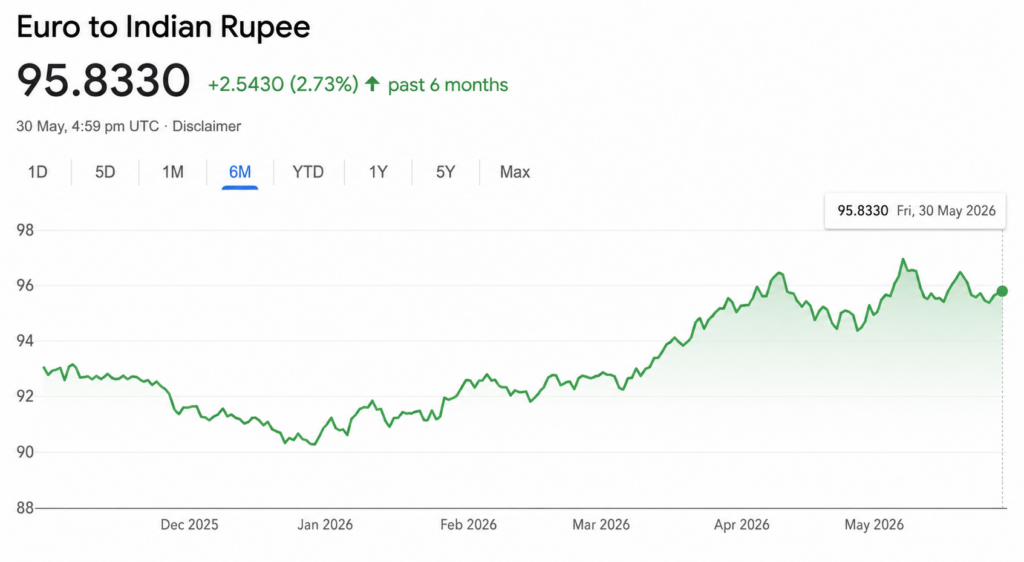
- Small shifts compound: One euro moving from ₹110 to ₹112 looks tiny on the sender’s side, but on €2,000 that’s a ₹4,000 difference for the receiver.
- Live tracking matters: Many transfer apps display the live EUR to INR rate before you confirm. Use that quote to decide when to lock in.
- Plan around news: Currency rates react to economic data, central bank announcements, and geopolitical events. A glance at finance news or a rate alert can help you pick a better moment.
Because the EUR to INR rate can change hour-to-hour, checking it at the moment you transfer is critical not the rate you saw yesterday.
What Drives the EUR to INR Rate
Several macroeconomic factors push the EUR to INR rate up or down:
- Interest rate differentials: Central bank policy is the largest driver. As of May 2026, the ECB’s deposit facility rate stands at 2.00%, while the RBI repo rate is 5.25%. A wider gap typically attracts foreign capital into Indian assets, which can support the rupee — though global uncertainty means this relationship is rarely straightforward.
- Inflation levels: Countries with lower inflation generally hold stronger currencies. India’s inflation in early 2026 has stayed within the RBI’s tolerance band, while eurozone inflation has been pushed up by energy prices.
- Trade and current account: India’s trade balance influences demand for foreign currency. A wider trade deficit tends to weaken the rupee since more rupees are converted to euros and dollars to pay for imports.
- Political and geopolitical events: Elections, policy shifts, or conflicts can move currencies sharply. Geopolitical tensions affecting global energy prices add volatility to the EUR to INR rate.
- In short, the real-time EUR to INR rate is the visible output of a constantly shifting balance of monetary policy, trade flows, and global sentiment.
How to Monitor the Real-Time EUR to INR Rate
To get the best value on a transfer, track the live EUR to INR rate rather than relying on the last figure you remember:
- Use mid-market sources: Google Finance and XE.com show the interbank rate — the true “wholesale” market price. This is your benchmark for comparing what any provider offers. For more on this, see our guide on the difference between mid-market, spot and customer rates.
- Set rate alerts: Most transfer apps and currency sites let you set a target EUR to INR rate and notify you when it’s hit. This removes the need to keep checking.
- Confirm before you commit: When you initiate a transfer, the platform will quote you a rate. Some show a “live” rate; others lock in a rate valid for a short window. Confirm the figure and complete the transfer quickly if it’s favourable.
- Always compare the quoted EUR to INR rate against the mid-market benchmark. Some providers add a hidden 1–3% margin while advertising “zero fees” see our breakdown of whether zero-fee transfers are really free.
How to Choose the Right Transfer Platform
Banks and traditional wire services typically charge fixed fees on top of a marked-up EUR to INR rate. A bank transfer can cost €15–€40 in fees plus an extra 1–3% built into the rate. Modern fintech apps usually advertise zero or low transfer fees and rates closer to the mid-market.
For a full side-by-side, see our post on banks vs money transfer apps. When choosing a service, focus on:
- Total cost, not just fees: An app with a zero transfer fee but a 3% rate markup will cost more on a large transfer than one with a €5 fee and a near-market rate.
- Hidden markups: Always verify the mid-market rate on Google or XE.com and compare it to what the provider shows. If the gap is wider than 0.5–1%, you’re paying a hidden fee.
- Transfer size: Where possible, consolidate smaller payments into one larger transfer. Many platforms either waive fees on larger amounts or apply a smaller percentage spread.
- Promotions: First-transfer bonuses and limited-time offers can save real money, but read the fine print to make sure the promotional rate isn’t undone by a worse spread.
How Different Providers Compare on a €1,000 Transfer
To make this concrete, here’s roughly what €1,000 yields in INR under different setups at a mid-market EUR to INR rate of ₹111:
| Provider Type | Typical Fee | Effective Rate | INR Received |
|---|---|---|---|
| Traditional bank (SWIFT) | €15–€30 | ₹108.30 (2.5% markup) | ~₹1,06,500 |
| Transparent-fee app | €4–€8 | ₹111.00 (mid-market) | ~₹1,10,100 |
| Zero-fee app with hidden markup | €0 | ₹109.50 (1.4% markup) | ~₹1,09,500 |
| ScopeX (zero fee + above mid-market) | €0 | ₹111.25 (25 paise above mid-market) | ~₹1,11,250 |
The difference between the best and worst option here is roughly ₹4,750 on a single €1,000 transfer. Over twelve monthly transfers in a year, that’s ₹57,000 enough to justify a careful choice of provider.
Top NRI Money Transfer Apps to Consider
NRIs in Europe have several options for sending money to India at competitive EUR to INR rates:
ScopeX: Built specifically for NRIs in Europe sending to India. ScopeX charges zero transfer fees and offers a rate 25 paise above the Google mid-market rate meaning your family receives more than the standard mid-market amount, not less. Transfers are fast, with 30 minutes delivery to all major Indian banks including ICICI, HDFC, and SBI. There are no hidden charges and no spread buried in the fine print. Trusted by 40,000+ NRIs with over €100M transferred.
Wise: Uses the mid-market exchange rate with a transparent, upfront fee that varies by amount and payment method. Transfers typically arrive in 1–5 days. Its rate transparency makes it easy to know what will land, though you are paying a service fee on top.
Remitly: Offers an Economy option (lower fee, slower) and an Express option (higher fee, faster delivery). Economy transfers typically take 3–5 business days.
Western Union, Xoom, Skrill: Long-established names that still work for cash pickups and certain corridors, though fees and rate markups are generally less competitive than newer apps.
Regardless of which app you choose, most modern services offer wide bank support, real-time tracking, encrypted security and 24/7 availability though see our guide on how weekend FX rate locking works if you transfer outside market hours.
7 Tips for Getting the Best EUR to INR Rate
- Check the interbank rate first: Search “EUR INR” on Google to see the real mid-market rate before you start a transfer.
- Compare at least two providers: Small differences in the EUR to INR rate can mean meaningfully more rupees on the same euro amount.
- Read past the headline fee: A “free” transfer with a 2% rate markup costs more than a €5 transfer at mid-market.
- Watch the trend: If you’re not in a hurry, observing the EUR to INR rate over a few days can help you pick a better moment. It moved between roughly ₹108 and ₹112 in the past 90 days, a meaningful range.
- Use rate alerts: Set a target and let the app or website notify you when it’s hit.
- Consolidate transfers: One larger transfer typically beats several small ones on both fees and rate spread.
- Avoid weekend submissions: FX markets are closed on weekends, so a Friday-evening transfer may use Thursday’s closing rate until Monday. Weekday transfers usually get a fresher rate.
Real-World EUR to INR Rate Example
Suppose you’re sending €2,000 to family in India. On a day when the EUR to INR rate sits at ₹110.50, you’d receive ₹2,21,000. On a day when it rises to ₹112.20, the same €2,000 yields ₹2,24,400, a difference of ₹3,400 from rate movement alone.
Now add the spread: if your provider takes a 1.5% margin, you’re down another ₹3,300 or so. The combined impact of rate timing and provider choice on a single mid-sized transfer can easily exceed ₹6,000 real money that should be reaching your family, not a middleman.
With ScopeX, you start 25 paise above the mid-market rate and pay zero fees, so you’re ahead before a single rupee is moved.
Frequently Asked Questions About the EUR to INR Rate
What is the current EUR to INR rate?
As of May 2026, the EUR to INR rate is trading around ₹111. The rate updates every few seconds during market hours, so check Google or XE.com before any transfer.
How often does the EUR to INR rate change?
Continuously during weekdays when FX markets are open. The rate can shift several times per minute and move 1–2% within a single day during volatile periods.
Is it better to send euros to India via a bank or an app?
For most personal transfers, apps offer a better EUR to INR rate and lower fees than banks. Banks remain useful for very large transactions where additional documentation or institutional relationships matter.
What is the mid-market rate, and why does it matter?
The mid-market rate is the real interbank EUR to INR rate without any markup. It’s the benchmark you should compare every provider’s quote against anything significantly worse is a hidden fee.
Can I lock in a EUR to INR rate in advance?
Some services let you lock a rate for a short window once you start a transfer. Others offer scheduled or recurring transfers that execute at the rate available on the day.
Are remittances to India taxed? Money sent to immediate family for support is generally not taxable on either side. For other situations large gifts, business payments, investments different rules apply. See our guide on the Double Taxation Avoidance Agreement and Tax Residency Certificate for tax-related transfers.
Sources & Disclaimer
EUR to INR rate figures referenced in this article are based on publicly available market data at the time of writing (May 2026). Rates change continuously and may differ by the time you read this. Always verify live rates and fees directly with your chosen provider before initiating a transfer.
Company names mentioned are included for illustrative and comparative purposes only. Any performance metrics, pricing examples, or user experiences referenced reflect publicly available information and should not be treated as guarantees. ScopeX’s 25 paise above mid-market rate and zero-fee structure reflects standard product terms as of the date of publication.
This content is intended for informational purposes only and does not constitute financial, investment, or tax advice. Readers should consult appropriate professionals for guidance specific to their situation.

Rishi is a Chartered Accountant (ICAI) and CFA (USA) currently heading Finance at ScopeX Fintech. With experience spanning fintech operations and strategic financial leadership, he writes sharp, practical insights on fundraising, financial modeling, risk, and more, bridging the gap between theory and the real fintech world.
RELATED ARTICLES
-

EUR to INR Real-Time Rates: How Exchange Rates Impact Your Transfer
EUR to INR Real-Time Rates: How Exchange Rates Impact Your Transfer Sending money from Europe to India means converting euros (EUR) into rupees (INR) at the current exchange rate. Even small shifts in the EUR/INR rate can change the amount your family receives. Exchange rates fluctuate constantly with global economics and events. For example, during […]
-

Difference Between Mid-Market Rate, Spot Rate and Customer Rate
When sending euros to India, understanding exchange rates can save you money. NRIs in Europe often see a quoted rate from their bank or service, but the true market rate can be different. The mid-market rate (also called the interbank rate) is the real currency price banks use when trading amongst themselves. The spot rate is essentially the same thing, […]
-

How Weekend FX Rate Locking Works in International Transfers
International money transfers are now fast and easy; almost like paying with a card. If you send money on a weekend, the app must fix an exchange rate even though markets are closed. Many services let you lock in (guarantee) the rate from Friday’s market close for weekend transfers. This means you know the exact […]