



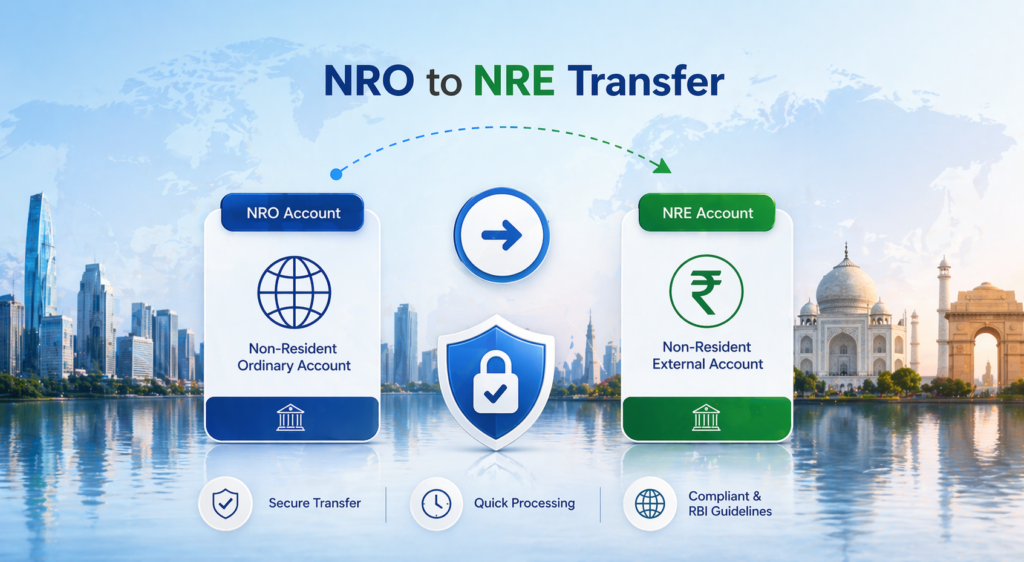
NRO to NRE Transfer: How to Repatriate Your Existing Indian Savings Legally
-
Author
Milan Agrawal -
Date
April 24, 2026 -
Read Time
8 min
TABLE OF CONTENTS
If you have money sitting in your NRO account – no matter if it is rental income, pension, or proceeds from investments, you may wonder how to move it abroad legally.
The truth is, you cannot directly transfer all of these funds to your German or UK bank account without following a defined process.
This guide walks you through everything that you necessarily need to know about an NRO to NRE transfer, in simple steps, so that you can move your money smoothly and compliantly.
Understanding the Difference: NRO vs. NRE Accounts
Both the NRO and NRE accounts are designed for Non-Resident Indians, but they serve very different purposes, especially when it comes to repatriation.
NRO (Non-Resident Ordinary) Account
This particular account holds income that is earned within India, like as:
- Rent
- Pension
- Dividends
- Interest
- Sale proceeds from assets
This income is taxable in India and comes with several restrictions on sending money abroad.
NRE (Non-Resident External) Account
This account holds funds that are transferred from abroad. Its key benefits include:
- Tax-free interest in India
- Fully repatriable funds (you can send money abroad freely)
Why should you transfer from NRO to NRE?
Because once your funds are in the NRE account, they become freely transferable abroad without any restrictions.
Is This Transfer Legal?
Yes, this transfer is completely legal.
NRO to NRE transfers are allowed under the Foreign Exchange Management Act (FEMA), 1999, as per RBI guidelines.
However, they are treated the same as outward remittances, which means:
- You must meet all the necessary documentation requirements.
- You must necessarily comply with the prevailing tax rules.
Important: There is a USD 1 million annual limit (April–March) on the total repatriation from your NRO account, including these transfers.
Which All Funds Are Eligible for Transfer?
Not all funds in your NRO account can be legally transferred. The eligible sources include the following:
- Rental income received from property in India
- Dividends from mutual funds or shares
- Interest from savings or fixed deposits
- Pension income
- Proceeds from sale of some financial assets (after tax)
- Property sale proceeds (after capital gains tax)
Important restriction:
Funds from agricultural land, plantation property, or farmhouses cannot be repatriated.
Documents That You Will Need
Before initiating the transfer, you should necessarily make sure you have the following documents handy:
- Form 15CA – It has to be filed by you on the Income Tax portal, declaring the source of funds.
- Form 15CB – It will be issued by a Chartered Accountant confirming tax compliance.
- Form A2 (FEMA Declaration) – It is your declaration of compliance with FEMA rules.
- Bank Transfer Request Form – It is provided by your bank.
- Proof of Source of Funds – You have to produce Rental agreement, sale deed, investment statement, etc. to prove your source of funds.
Tip: Always download and save the acknowledgement of Form 15CA – banks will ask for it.
Step-by-Step Transfer Process
Here is how the process typically works:
- Check Eligibility
Ensure that your funds are from valid sources and all taxes have been paid or deducted. - Consult a Chartered Accountant
Your CA verifies the source of income and issues Form 15CB. - File Form 15CA Online
Submit details on the Income Tax portal using the information of your CA. - Fill Your Bank’s Transfer Form
Provide details like as amount, source, and destination (NRE account). - Submit Documents to Your Bank
Your bank (Authorised Dealer) will review everything for compliance. - Transfer Is Processed
Once approved, funds are moved from your NRO to NRE account – usually within a few working days.
Real-Life Example
Priya lives in Frankfurt and earns rental income from her property in Hyderabad. Over a year, she receives ₹5.4 lakh in her NRO account, with TDS already deducted.
She wants to use this money abroad.
She hires a CA, obtains Form 15CB, files Form 15CA, and submits all the necessary documents to her bank. After the routine verification, the funds are transferred to her NRE account.
From there, she can send the money to Germany anytime – without additional approvals.
What Happens After the Transfer?
Once your funds reach the NRE account, they are fully repatriable.
You can send money to any overseas bank account without:
- Additional RBI approvals
- Form 15CA or 15CB
- Extra documentation
At this particular stage, your main consideration is choosing the right time and service for the purpose of currency conversion.
Common Mistakes to Avoid
These are some of the most frequent issues that cause delays:
- Not filing Form 15CA beforehand
- Unpaid taxes on the income generated by you
- Using an inexperienced CA
- Mixing foreign income into NRO accounts
- Exceeding the USD 1 million limit without an approval
Planning ahead can save you time and unnecessary complications.
A Note on Double Taxation
India has Double Taxation Avoidance Agreements (DTAA) with countries like Germany, the UK, France, and the Netherlands.
If you have already paid tax in India, you may be able to claim a credit in your country of residence, helping you avoid paying tax twice.
It is best to consult a tax advisor in your country for exact procedures.
Quick Summary
- NRO to NRE transfers are considered legal under RBI and FEMA rules.
- Annual repatriation limit is USD 1 million.
- Only eligible, taxed income can be transferred.
- Forms 15CA, 15CB, and bank documentation are mandatory.
- Once funds reach NRE, they can be freely sent abroad.
Conclusion
Repatriating your Indian income does not have to be complicated if you follow the right process.
The key is simple: stay compliant, keep your documents ready, and plan ahead.
Once your funds move into your NRE account, managing your finances across countries becomes much easier and also more flexible.
Disclaimer: This article is for informational purposes only and does not constitute financial, legal, or tax advice. Regulations may change, and individual circumstances vary. Always consult your bank, a qualified Chartered Accountant, or a FEMA expert before initiating any transfer.

Milan Agrawal, is the Co-founder and CEO of ScopeX, a blockchain-powered fintech platform enabling zero-fee money transfers for Indians across Europe. An IIT Delhi alumnus based in Berlin, Milan built ScopeX to make cross-border remittances faster, fairer, and more transparent for the Indian diaspora. He is an active voice in the global fintech space, having spoken at TOKEN2049, Global Fintech Fest, and Stellar Meridian.
RELATED ARTICLES
-

Capital Gains Tax for NRIs: How It Works, Rates, and Key Rules in India
Why Capital Gains Tax Matters for NRIs Many NRIs invest in India through property, mutual funds, shares, or other financial assets. While these investments can generate strong long-term returns, profits earned from selling them are subject to capital gains tax in India. For NRIs, capital gains taxation often feels complex due to overlapping tax rules, higher tax […]
-
Transferring Funds from an NRO Account: Rules, Limits, and What NRIs Should Know
Why NRO Account Transfers Require Extra Care For NRIs, the Non-Resident Ordinary (NRO) account is the primary account used to receive income earned in India—such as rent, dividends, pensions, or proceeds from asset sales. While operating an NRO account is straightforward for receiving funds, transferring money out of it—whether within India or abroad—comes with regulatory and tax considerations that […]
-

Sending Money from Germany to India: Tax Implications NRIs Should Understand
Why Tax Clarity Matters for Germany–India Remittances Germany is home to a large and growing Indian diaspora, including professionals, students, and long-term residents. For many, sending money to India—whether for family support, investments, or savings—is a regular financial activity. While the act of transferring money is straightforward, the tax implications are often misunderstood, especially when navigating […]