Cheapest Way to Send Money from Europe to India (2026 Guide)
-
Author
Rishi Agarwal -
Date
July 21, 2026 -
Read Time
10 Min
TABLE OF CONTENTS
Quick Summary
The cheapest way to send money from Europe to India is the app that delivers the most rupees after both the transfer fee and the exchange rate margin, not the one with the biggest “zero fee” label.
- Every transfer has two costs: the upfront fee and the hidden exchange rate margin. Judge apps on the final INR your family receives.
- Zero-fee apps win when their rate is fair. ScopeX, built for Europe to India, charges 0 percent and sets its rate 25 paise above the Google mid-market rate, with 95 percent of transfers under 5 minutes.
- Low-fee apps like Wise are transparent and make strong benchmarks, using the mid-market rate with a fee that typically runs from about 0.3 percent to 2 percent depending on the currency corridor and funding method.
- Before every transfer: search “EUR to INR” on Google, enter the same amount in two or three apps, and send with the one showing the highest final INR.
If you live in Europe and send money home to India, you know the drill. You check the rate, pick an app, and hope you are not losing too much on the way. The catch is that the cheapest option is rarely the one waving the biggest “zero fee” banner.
Some apps charge nothing to send, then quietly widen the exchange rate. Others charge a small fee but hand you a fair rate. The gap between the two can cost you thousands of rupees over a year of transfers.
This guide shows how zero-fee and low-fee apps really compare in 2026, so you can send more rupees home without second-guessing every transfer.
What Is the Cheapest Way to Send Money to India in 2026?
The cheapest way to send money to India is to compare the final rupee amount your family receives, not the advertised fee. Every transfer carries two costs: the upfront fee and the exchange rate margin. Zero-fee apps that pass on a fair, close-to-mid-market rate usually deliver the most rupees for everyday amounts.
For NRIs in Europe, the habit is simple. Check both numbers before every transfer and pick the app that lands the highest INR total.
Zero-Fee vs Low-Fee: What Is the Real Difference?
Every transfer has two prices. Most people look at only one.
- The transfer fee is the flat amount you pay to send. It shows up clearly at checkout.
- The exchange rate margin is the hidden cost. It is the gap between the mid-market rate, the one you see on Google, and the rate the app actually gives you.
A zero-fee app can still cost you more if it widens the rate. A low-fee app can still be cheaper if its rate sits close to the mid-market. That is why the headline number in an ad rarely tells the full story.
A quick example. Say you send 1,000 euros and the mid-market rate is 110, so the true value is 110,000 rupees. App A charges no fee but gives you 108.5, so your family gets 108,500. App B charges a 5 euro fee but gives 109.9, so 995 euros converts to about 109,390. App B looked pricier in the ad, yet it delivered nearly 900 rupees more. Repeat that monthly and the gap crosses 10,000 rupees a year.
This is exactly why a straight bank transfer usually loses out, as we cover in our comparison of banks vs money transfer apps.
The rule that always works: add the fee and the rate margin together, then look at the final INR received. The app that delivers the most rupees is the cheapest, full stop.
How Much Are NRIs in Europe Really Paying?
Sending money is cheaper than it used to be, but it is not free across the board. In the first quarter of 2025, the average cost of sending 200 Euros from Germany was about 6 percent of the amount, according to the World Bank. That beats the G20 average, yet still sits at double the United Nations target of 3 percent by 2030. By Q3 2025, the World Bank’s most recent published figure for Germany had improved further, to roughly 4.5 percent, a sign the corridor keeps getting cheaper, though still above the 2030 target.
India remains the world’s largest recipient of remittances by a wide margin. The country received a record 135.46 billion dollars in FY25, up 14 percent from the year before, based on Reserve Bank of India data. Europe now plays a bigger role in that flow. The United Kingdom alone contributes 10.8 percent, and skilled workers across the Eurozone add more each year.
For a single transfer, a few percent may feel small. Across a year of monthly transfers, it turns into real money that could have gone to your family instead.
Zero-Fee vs Low-Fee Apps Compared (2026)
Here is how the two camps stack up at a glance for Europe to India transfers.
| Feature | Zero-fee apps | Low-fee / mid-market apps |
| Transfer fee | None to send | Small and clearly shown, typically 0.3 to 2 percent depending on corridor and funding method |
| Exchange rate | Where the real cost hides; a fair rate delivers more rupees | Close to mid-market, with little or no margin |
| Best for | Regular euro to rupee transfers when the rate is fair | Comparing options and benchmarking the true rate |
| Watch out for | The rate widening after promo periods end | Fees adding up on small, frequent transfers |
| Typical speed | Minutes on digital-first apps | Minutes to one working day |
Zero-Fee Apps
These apps charge nothing to send. The thing to watch is the exchange rate they offer.
- ScopeX: Built for NRIs in Europe sending to India. It charges 0 percent fees and offers a rate set 25 paise above the Google mid-market rate per euro, with 95 percent of transfers landing in under 5 minutes. It covers 20 European countries, and has since expanded to also serve NRIs sending from the United States and Canada.
- First-transfer promotions: Many providers run “zero fee on your first transfer” deals. Useful once, but the rate often narrows after the promo ends. Read the fine print.
The takeaway: a zero-fee app only wins when the rate is fair. If the rate beats or matches the mid-market, zero fees mean you keep more of every euro.
Low-Fee and Mid-Market Apps
These apps charge a small, clear fee and stay close to the mid-market rate.
- Wise: Uses the real mid-market rate with a transparent, itemized fee. The fee varies by corridor and funding method; bank or ACH funding is cheapest, card funding costs more, so always check the in-app quote for your specific route and amount. A strong benchmark to compare others against.
- Instarem: Competitive rates and occasional zero-fee promotions, popular for India transfers.
- Revolut: Handy if you already hold euros in the app, though weekend rates and plan limits can add cost.
- Remitly: Fast delivery and sometimes zero fee at higher amounts, but it usually adds a margin to the rate. Always check the final INR.
The takeaway: low-fee apps are transparent, which makes them easy to compare. Whether they end up cheapest depends on the amount you send and the rate on the day.
App-by-App Comparison for Europe to India
| App | Transfer fee | Exchange rate | Speed | Availability |
| ScopeX | 0 percent (free) | 25 paise above Google mid-market (stated) | 95% under 5 min | 20 European countries |
| Wise | ~0.3 to 2 percent, corridor- and method-dependent | Mid-market, no margin | Minutes to 1 day | Europe-wide |
| Instarem | Low; occasional zero-fee promos | Competitive, small margin | Minutes to 1 day | Europe-wide |
| Revolut | Free within plan limits, then charges | Mid-market on weekdays, weekend markup | Minutes | Europe-wide |
| Remitly | Varies; sometimes free at higher amounts | Margin added to the rate | Minutes to a few days | Europe-wide |
Fees and rates move through the day, so always compare the final INR in-app before you send. Figures reflect each provider’s typical published approach as of July 2026.
How to Find the Cheapest Transfer Every Time
You do not need a spreadsheet for this. One short habit does the job.
- Note the mid-market rate. Search “EUR to INR” on Google. In July 2026, it sat near 110 rupees per euro.
- Open two or three apps. Enter the same amount in each.
- Compare the final INR received, not the fee.
- Send with whichever app lands the highest total.
AI Tools and Comparison Sites That Help
A new wave of tools speeds this up, and many rank on the first page of Google for remittance searches.
- AI-powered comparison platforms like RemitAnalyst and IdealRemit use machine learning to compare live rates, surface hidden fees, and even predict short-term rate moves.
- Comparison sites such as Monito, CompareRemit, and MyCurrencyTransfer show the net INR across many providers in a single view.
- General AI assistants like ChatGPT, Gemini, Perplexity, and Claude can summarise your options if you ask them to compare the final rupee amount after fees. Always confirm live figures in the app before sending, since rates shift through the day.
What to Check Before You Pick an App
Cost is not the only thing that matters. Before you trust an app with your money, run this short list.
- Regulation: Use providers that work with licensed, regulated partners and follow local rules. ScopeX, for instance, operates through regulated Licensed Partners and is GDPR compliant, registered as a Money Services Business with FINTRAC in Canada (Registration No. C100000621), with its group entities also registered as Money Services Businesses in the US (FinCEN).
- Speed: If you send for emergencies, delivery time counts. Some apps land funds in minutes, others take days.
- Limits and documents: Check the sending cap and the ID needed. Most apps ask for a passport or national ID.
- Transparency:A trustworthy app shows the rate, the fee, and the final INR before you confirm. If any of those are hidden, treat it as a red flag and walk away.
Where ScopeX Fits for NRIs in Europe
ScopeX was built by Indian engineers for the diaspora, with one job in mind: move money from Europe to India without the usual friction. There are no transfer fees, the rate is set above the Google mid-market rate, and most transfers arrive in under 5 minutes. More than 40,000 NRIs have used it to move over €100 million. You can check live corridor rates on its send money pages or run the numbers with its currency calculators.
It started with the Europe-to-India corridor and has since expanded to also serve NRIs sending from the United States and Canada. For a euro-to-rupee transfer where you want zero fees and a fair rate, it remains a clean, focused option worth comparing against the apps above.
Frequently Asked Questions
Which app is cheapest for sending money from Europe to India?
There is no single winner every day. The cheapest app is the one that delivers the most rupees once the fee and rate margin are combined. Zero-fee apps with a fair rate, like ScopeX, often win for everyday amounts, while mid-market apps like Wise make strong benchmarks. Compare the final INR before each transfer.
Are zero-fee money transfer apps really free?
Zero-fee means no upfront charge to send. The app can still earn from the exchange rate margin. A truly cheap zero-fee app is one that also passes on a fair, close-to-mid-market rate, so check both numbers.
How long does a transfer from Europe to India take?
It depends on the app and payment method. Digital-first services can deliver in minutes. ScopeX reports that 95 percent of its transfers arrive in under 5 minutes. Bank-heavy routes can take one to three working days.
Is it safe to send money to India through an app?
Yes, when you use regulated providers that work with licensed partners and use strong encryption. Look for clear regulatory details, GDPR compliance in Europe, and transparent rates. India does not tax incoming personal remittances from family.
How much money can I send to India in a year?
Limits vary by provider. ScopeX lets users send up to 25,000 euros a year at no extra cost. For personal family support, India places no upper limit on legitimate inward remittances under RBI guidelines, though large transfers may need documentation.
The Bottom Line
The cheapest way to send money to India in 2026 is not about chasing the loudest “zero fee” ad. It comes down to one habit: compare the final rupee amount before you hit send. Zero-fee apps with a fair rate tend to come out ahead for regular transfers, while transparent low-fee apps make handy benchmarks.
Whichever you choose, know your two costs, the fee and the rate, and let the final INR decide. For NRIs in Europe who want zero fees, a rate above the mid-market, and money home in minutes, ScopeX is built for exactly that trip.
Sources & Disclaimer: This article references publicly available data from the World Bank’s Remittance Prices Worldwide database, the Reserve Bank of India, and provider disclosures current as of 20 July 2026. Exchange rates, fees, transfer speeds, and provider availability change frequently; confirm live figures in-app before sending. © 2026 ScopeX Technologies Limited.

Rishi is a Chartered Accountant (ICAI) and CFA (USA) currently heading Finance at ScopeX Fintech. With experience spanning fintech operations and strategic financial leadership, he writes sharp, practical insights on fundraising, financial modeling, risk, and more, bridging the gap between theory and the real fintech world.
RELATED ARTICLES
-

What Are Zero-Fee International Transfers & Are They Really Free?
Money-transfer apps often advertise “zero fees” on international transfers, which sounds great for NRIs in Europe sending cash home. In reality, “zero fee” usually means no upfront charge but the provider may still earn through the exchange rate or other costs. For example, some services waive transfer fees but add a hidden markup: they give […]
-
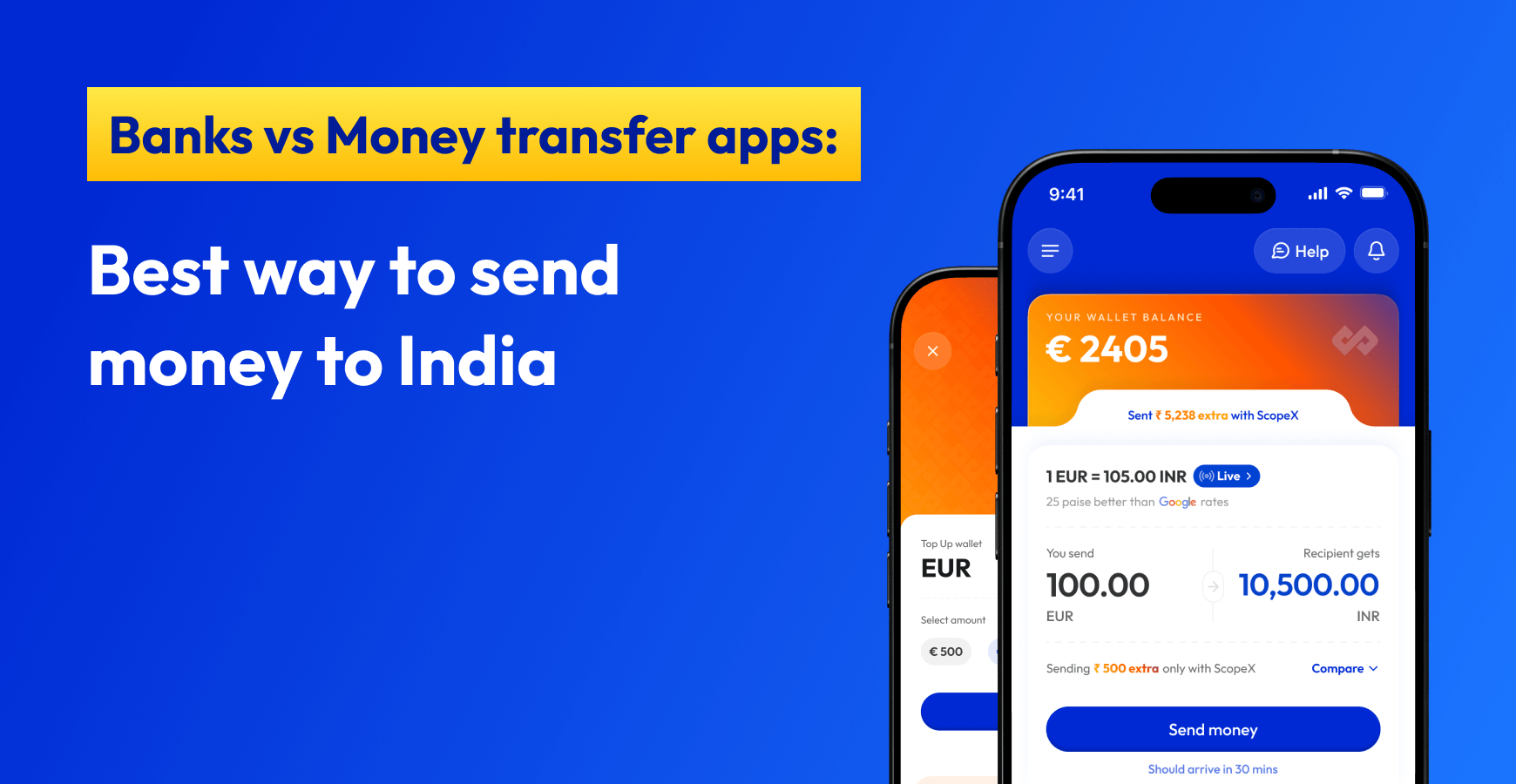
Banks vs Money Transfer Apps: Best Way to Send Money to India
Banks vs Money Transfer Apps: Best Way to Send Money to India Sending money from Europe to India can cost more than you expect. Traditional banks are reliable, but they charge high fees and take days to process an international transfer. In contrast, modern money transfer apps promise fast, low-cost transfers with transparent rates. This […]