SEPA Transfer to India: The Complete Guide for NRIs in Europe 2026
-
Author
Rishi Agarwal -
Date
July 16, 2026 -
Read Time
8 Min
TABLE OF CONTENTS
Quick Summary
You cannot make a SEPA transfer to India. SEPA is a euro-only payment area covering 41 European countries and territories, and India isn’t one of them. Indian banks use IFSC codes, not IBANs, and the rupee isn’t the euro.
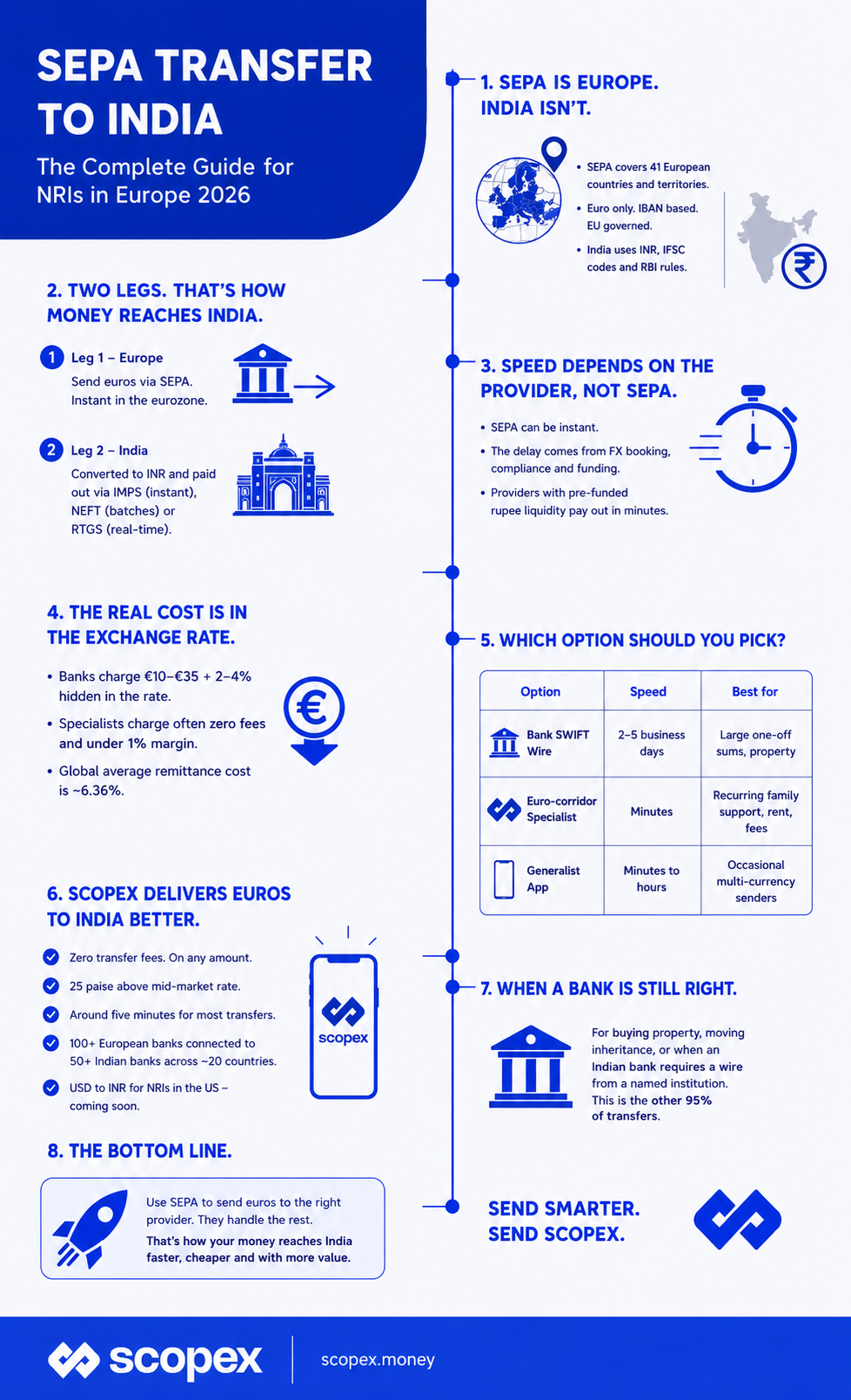
What you can do and what every fast Europe-India transfer actually does is use SEPA for the first leg only: moving euros from your European bank to a licensed remittance provider. That provider converts EUR to INR and pays out over India’s domestic rails. Two legs, stitched together.
With a euro-corridor specialist like Scopex, that round trip finishes in around five minutes with no transfer fee. With a bank wire, it takes two to five business days and costs €10-€35 plus a margin you never see itemised.
What SEPA covers and why India sits outside it
The Single Euro Payments Area makes a euro transfer between member countries work like a domestic one. According to the European Central Bank, it spans 41 countries and territories: all 27 EU states, the EFTA four, the microstates, the UK after Brexit, and since 2025, several enlargement partners including Albania, Montenegro and Serbia.
Three rules define it and India fails all three:
- Euro only: The rupee isn’t the euro.
- Built on the IBAN: Indian banks use IFSC codes instead.
- EU-governed: India runs on FEMA under the Reserve Bank of India, not EU regulation under the European Payments Council.
There’s no overlap, and no proposal to create one.
What has changed is speed. Regulation (EU) 2024/886 made instant euro transfers mandatory for eurozone banks receiving from January 2025, sending from October 2025, with funds landing in ten seconds and no premium charge. Banks in non-euro EU countries like Poland and Sweden have until 2027, so if you bank there, instant may not be available yet.
Since October 2025, your bank must also check the payee’s name against the IBAN before you confirm. Useful, but it checks the European leg only. It cannot verify your mother’s name against her Indian account number.
How your money actually reaches India
Leg 1 – Europe. You push euros from your bank to your provider by SEPA Credit Transfer or SEPA Instant. In the eurozone, near-instant.
Leg 2 – India. The provider converts EUR to INR and pays out domestically: IMPS (instant, 24/7, up to ₹5 lakh per transaction), NEFT (24/7, half-hourly batches, no maximum) or RTGS (real-time, ₹2 lakh minimum). Most family remittances go via IMPS.
So where do the three days go? Not SEPA, and not IMPS. The delay sits in the middle of FX booking, compliance screening, and, above all, the provider’s funding model. A provider that pre-funds rupee liquidity in India can pay out before your euros have even settled, which is what makes an emergency transfer possible at all. A correspondent bank chain moving money through SWIFT can’t: each hop adds a day and a possible deduction.
That’s why “SEPA is instant, but my bank transfer took four days” isn’t a contradiction. Your bank never used SEPA for the India leg at all.
What it really costs and how the options compare
The true cost = the visible fee + the exchange-rate margin. Most people only see the first one.
Say mid-market is ₹109.50 to the euro. Your bank quotes ₹106.75, a 2.5% margin, invisible and unitemised, worth about ₹2,750 on €1,000. The €12 “transfer fee” was never the point. The fee is the part they show you.
Priya, a data engineer in Munich, sends money from Germany to India every month. Her bank’s fee plus margin costs her roughly €37 per transfer, or nearly ₹36,000 a year. She did nothing wrong. She used a channel built for corporate treasury to send money to her mother.
| Bank SWIFT wire | Euro-corridor specialist | Generalist app | |
| Speed | 2–5 business days | Minutes | Minutes to hours |
| Visible fee | €10–€35 + possible deductions | Often zero | Low, percentage-based |
| FX margin | Commonly 2–4% | Under 1% | Typically 0.4–1% |
| Best for | Large one-off sums, property | Recurring family support, rent, fees | Occasional multi-currency senders |
For context, the World Bank’s Remittance Prices Worldwide puts the global average cost at roughly 6.36% of the amount sent, with digital operators well under 4% and banks far higher. The gap between a bank and a specialist app is wide enough that it’s worth comparing banks vs money transfer apps before your next transfer.
When a bank is still right: buying property, moving an inheritance, or where an Indian bank wants a wire reference from a named institution. This guide is about the other 95% of transfers.
Where Scopex fits
Most transfer apps are built to move any currency anywhere. Scopex was built to do one thing exceptionally well: get euros into Indian bank accounts fast, with nothing skimmed on the way. That’s a deliberate engineering choice, and you can see it in the numbers.
- Zero transfer fees. No flat charge, no deduction in transit, on any amount and unlike some zero-fee transfers, nothing quietly recovered through the rate.
- 25 paise above the mid-market rate, above the rate you see on Google, not merely close to it. On €1,000 that’s roughly ₹250 extra reaching your family, on top of the fee you never paid.
- Around five minutes for most transfers, because Scopex runs the Indian leg on domestic rails instead of waiting on a correspondent bank chain.
- Serious corridor depth: 100+ European banks connected to 50+ Indian banks across roughly 20 European countries, from France and Spain to the Netherlands and Ireland.
That corridor expertise is now travelling. USD to INR for NRIs in the United States is on the roadmap, bringing the same model, no fees, a published rate, and minutes, not days, to the largest India remittance corridor in the world.
Scopex operates its European services through regulated, licensed partners holding their own authorisations, and does not hold customer funds.
Don’t take a marketing page’s word for it, including this one. Pull a live quote for €1,000, search “EUR to INR” on Google, then quote the same amount at your bank. Compare the final INR figure across all three. Not the fee. The rupees that land.
NRE, NRO, or a resident account?
The most expensive decision on this page and it has nothing to do with your provider.
| NRE | NRO | Resident savings | |
| Whose money | Your foreign earnings | Your India-sourced income | Your family’s own account |
| Is interest taxed in India? | No exempt | Yes, TDS applies | Per their own position |
| Repatriable? | Fully | Up to USD 1M/year, with Form 15CA/15CB | N/A |
| Use it for | Saving in India, or SIP investing | Rent, dividends, pension | Support to parents, spouse, and siblings |
Rule of thumb: Money for you goes to an NRE account. Money for them goes to their own account. Never send a gift into your own NRE account and call it family support. The account’s purpose and the transaction’s purpose have to agree.
Tax: What NRIs should know
Money you send isn’t income for the recipient, so it isn’t taxed on arrival. Under Section 56(2)(x) of the Income-tax Act, 1961, gifts from specified relatives, spouse, siblings, parents, children, grandparents, grandchildren and their spouses are fully exempt with no upper limit.
Notice who isn’t there: cousins, aunts, uncles and friends. Gifts to non-relatives are exempt only up to ₹50,000 per financial year; cross that and the entire amount becomes taxable.
And the myth worth killing: TCS doesn’t apply to you. Tax Collected at Source applies to residents sending money out of India under the Liberalised Remittance Scheme. You’re sending money in.
Your European position is separate, and a Double Taxation Avoidance Agreement may apply. Get advice in your country of residence before large or recurring transfers, and work through the NRI financial checklist before the July filing deadline. Verify Indian rules at the Income Tax Department and the RBI.
How to send: step by step
- Choose a regulated route. Your provider should operate under PSD2 or through EU/EEA-licensed partners. Ask which entity holds the licence.
- Complete KYC once: passport or national ID, plus proof of address.
- Add the beneficiary carefully. Name, account number, IFSC. A wrong IFSC is the most common cause of failure, and Verification of Payee won’t catch it.
- Check the final INR, not the fee, and confirm the purpose code (P1301 for family maintenance, P1302 for gifts).
- Fund by SEPA, then keep the confirmation.
Wrong IFSC? Contact your provider immediately. Recall processes exist, but success depends on whether the recipient bank has already credited the funds.
Seven mistakes that cost NRIs money
- Comparing fees instead of the final INR. The fee is the part they show you. The margin is the part they don’t.
- Sending gifts into your own NRE account. The account’s purpose and the transaction’s purpose must agree.
- Assuming “relative” means what you think it means. Cousins are not relatives under Section 56(2)(x). That ₹50,000 threshold is real.
- Paying by credit card. Cash-advance fees plus a worse rate. Funds from a bank account.
- Believing TCS applies to inbound money. It doesn’t. It applies to residents sending money out.
- Ignoring the double conversion. Sending from Sweden or the UK? You’re paying two spreads. Hold euros where you can.
- Never re-checking your provider. Rates and models change. The provider that was best in 2024 may not be in 2026. Re-run the ninety-second check twice a year.
FAQ
Can I make a SEPA transfer to India?
No. SEPA only handles euro payments between accounts in its 41 participating countries and territories, and India isn’t one of them. SEPA can only carry the euro leg to your provider; the rupee leg runs on India’s domestic rails.
How long does a transfer from Europe to India take in 2026?
With a euro-corridor specialist funded by SEPA Instant, minutes Scopex says most complete in around five. A bank SWIFT wire typically takes two to five business days. The delay is rarely the SEPA leg.
Is there a limit on how much I can send to India?
FEMA places no cap on an NRI remitting foreign earnings into India through banking channels. Limits come from your provider’s tiers and anti-money-laundering thresholds.
Do my parents pay tax on the money I send them?
No. Parents are specified relatives under Section 56(2)(x), so the gift is fully exempt with no upper limit. Any interest it later earns is taxable in their hands.
Do I need an NRE account to receive money from Europe?
Only if the money is yours. Sending to parents or family? It lands in their ordinary resident savings account completely normally.
The takeaway
“SEPA transfer to India” describes something more interesting than it sounds: a euro system that got dramatically faster in 2025–26, connected to an Indian system that’s been instant since 2010. Both ends are ready. Whatever you’re losing now, you’re losing in the middle, in margins you never saw and fees you never needed to pay.
Know which account the money should land in, declare the right purpose, and judge every provider on the rupees that arrive rather than the fee they advertise.
If you send euros to India regularly, Scopex is built for exactly that trip zero transfer fees, a published rate 25 paise above mid-market, and most transfers landing in around five minutes. Pull a live quote and decide on the numbers.
Disclaimer
This article is general information only and is not financial, tax, legal or regulatory advice. Rules under FEMA, the Income-tax Act, 1961, RBI regulations and EU payments legislation change, and their application depends on your circumstances and country of residence. Rates, fees, speeds and limits vary by country, payment method and bank, and may change without notice. Past exchange rates are not indicative of future rates. All figures are illustrative, reflect sources available in July 2026, and are not guarantees. Verify current rates and terms before transacting, and consult a qualified professional in both India and your country of residence.

Rishi is a Chartered Accountant (ICAI) and CFA (USA) currently heading Finance at ScopeX Fintech. With experience spanning fintech operations and strategic financial leadership, he writes sharp, practical insights on fundraising, financial modeling, risk, and more, bridging the gap between theory and the real fintech world.
RELATED ARTICLES
-

What Is an International Bank Account Number (IBAN)? Everything You Need to Know
Quick summary An IBAN is a standard code that names one bank account for cross-border payments. It holds up to 34 characters: a 2-letter country code, 2 check digits, and the local account details (the BBAN). The check digits let a bank catch a typo before the money leaves. They do not confirm the account […]
-

Emergency Fund Transfer from Europe to India: Fastest Ways to Send Money in Minutes
(TL;DR) Need to send money from Europe to India in an emergency? The fastest, lowest-cost route in 2026 is a digital remittance app that pays directly into an Indian bank account. With ScopeX, eligible transfers from the Eurozone reach Indian bank accounts in as little as 5 minutes with 0% transfer fees and an exchange […]
-

Nostro & Vostro Accounts Explained for Sending Money to India
If you’ve ever sent euros to India through a bank or a money transfer service, you’ve used a system involving Nostro and Vostro accounts even if you didn’t know it. These accounts help banks move money between countries without delays or surprises. While you never see them, they make sure your euros get converted into […]